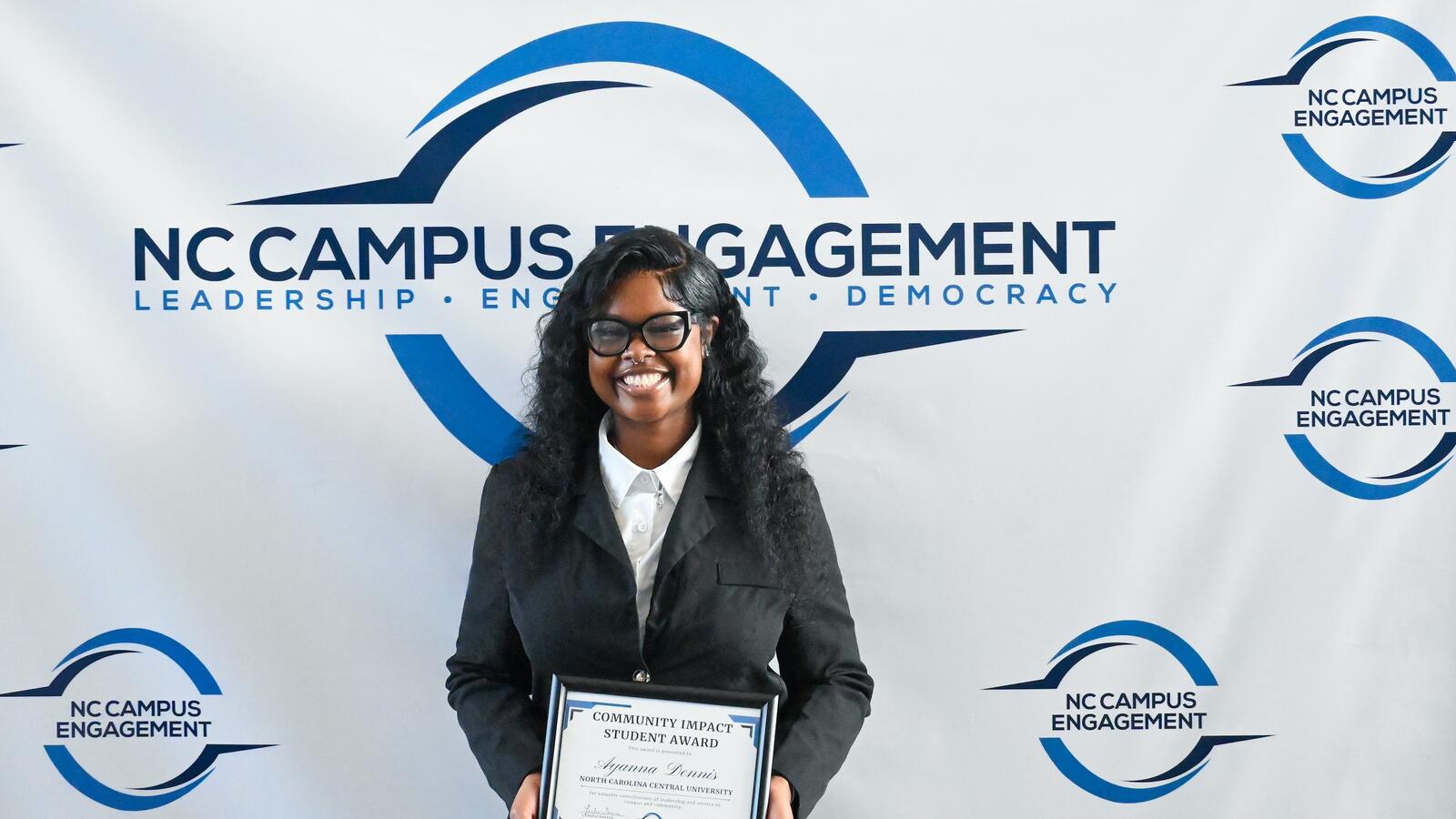
Ayanna Dennis didn’t expect to be recognized for her work. If anything, the North Carolina Central University (NCCU) senior thought she needed to do more.
So, when Dennis learned she had been selected for the Community Impact Student Award from NC Campus Engagement, her first reaction was disbelief, followed quickly by gratitude.
“I was honestly amazed,” Dennis said. “I felt like I wasn’t doing enough for the community. Being awarded this was incredible and meeting other student leaders with the same mindset made it even more powerful.”
Dennis, a senior social work major, was honored at the 2025 Citizenship, Service, Networking and Partnerships (CSNAP) Student Conference on Nov. 8. The award recognizes one student at each participating institution for outstanding leadership, service and sustainable community impact.
At NCCU, Dennis’ impact is hard to miss.
As president of the Social Work Society, she has become a connector linking students to information, resources and each other. She leads with urgency and intention, making sure service isn’t just talked about, but done.
“I want action behind the words,” Dennis said. “If you’re volunteering, I want to know why. Are you here just for the hours, or because you genuinely care?”
That mindset drives her work with Durham’s unhoused populations. Dennis, together with Calleen Herbert, director of community engagement and service, recently applied for a NC Campus Engagement grant to support a hygiene and food distribution event focused on sustainability rather than short-term fixes. If received, instead of serving hot meals, they plan to prepare supply bags designed to provide resources that last beyond a single day.
“They’re not just hungry for one day,” she said. “We wanted to give them something they could stretch.”
Her advocacy is personal. Dennis regularly checks on unhoused residents she passes on her route to campus, including a veteran with mobility challenges she sees often near NCCU. She offers water, snacks or whatever support she can in the moment,
Supporting Peers, Strengthening the Program
That same care extends to her peers.
Dennis support students through the Bachelor of Social Work (BSW) application process, helping the program reach double the number of applications received in fall 2025. She broke down deadlines, clarified requirements and created shared spaces, including GroupMe chats, where students could ask questions without fear of judgment.
“A lot of students didn’t even know where to find the application or the curriculum,” she said. “So, we made it simple. Dates, links, reminders: everything in one place.”
According to Laura Armstrong, director of the BSW program, Dennis is “highly organized and deeply committed to ensuring that all social work students, and anyone interested since the organization is open to all, have at least one event each semester that truly speaks to their interests. If she feels an issue is important, she makes sure others are aware of related events, and she is equally willing to attend on her own if needed.”
She also coordinated peer reviews for essays, explained recommendation letter rules and encouraged students to apply early.
“It’s a community,” Dennis said. “If I don’t know the answer, someone else does. We help each other.”
Beyond campus, Dennis volunteers with Habitat for Humanity, an experience she says reshaped how she understands service.
“You’re not just building a house,” she said. “You’re working alongside the people who will live there. They’ve earned it. That changes everything.”
The homes, located just minutes from NCCU, now stand finished with families moved in, a visible reminder of lasting impact.
From Criminal Justice to Social Work
Dennis’ path to social work wasn’t direct. She arrived at NCCU as a criminal justice major but shifted after reflecting on her own childhood and a desire to support young people before they become defined by systems meant to punish.
“I always wanted someone in my corner,” she said. “Especially for kids who come into contact with law enforcement early. Once they’re labeled, that label sticks.”
Now, Dennis plans to become a forensic social worker, working with both youth and adults impacted by the justice system. She plans to remain in Durham, pursue her master’s degree at the University of North Carolina at Chapel Hill and continue serving the community she calls home.
As for her legacy at NCCU, Dennis doesn’t see an ending, just continuity.
“I want to come back,” she said. “I want students to know I’m still here for them. Even after life moves on.”