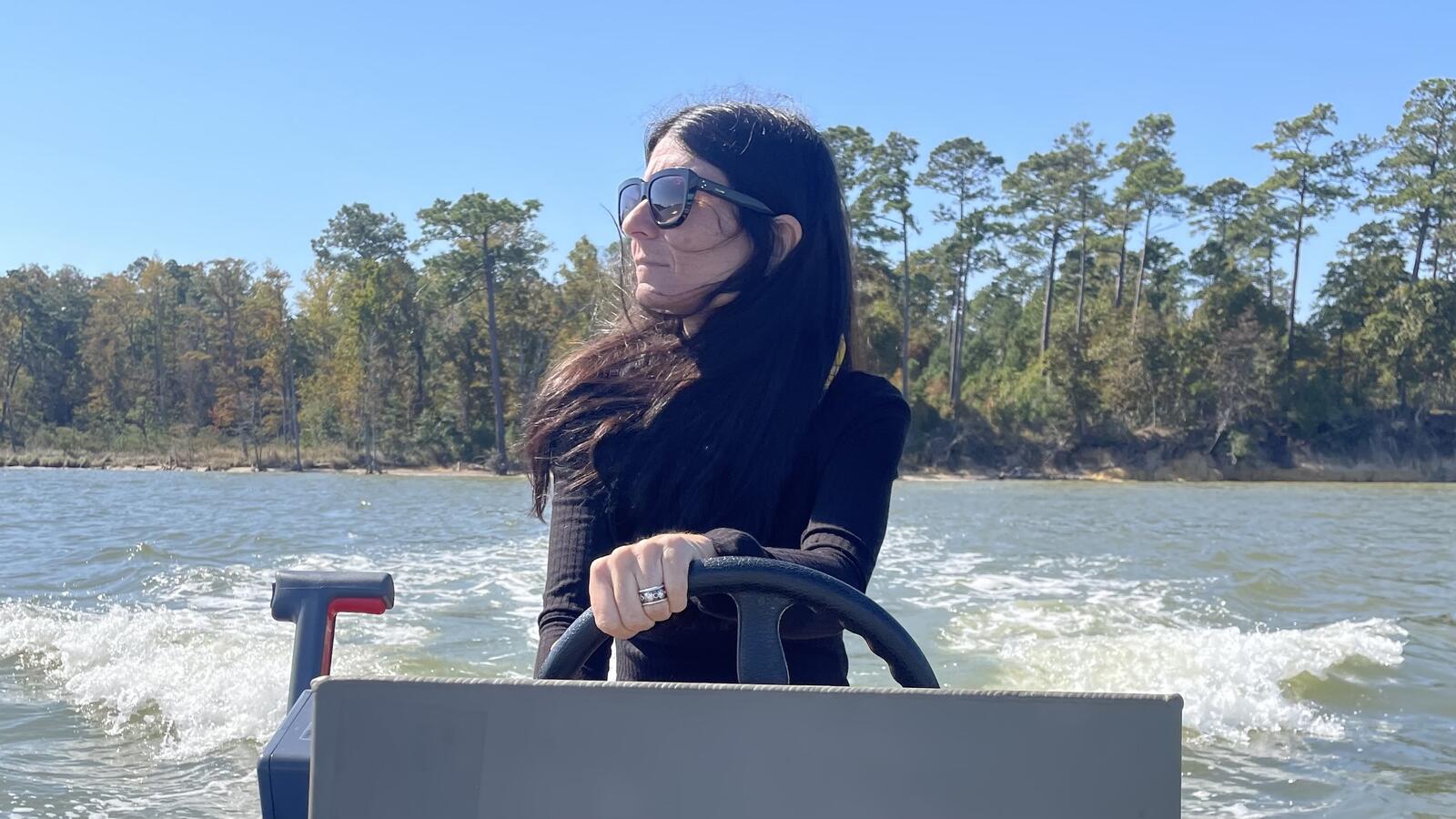
Some people earn a college degree (or two) and then move into a career. Lisa Rider built her career in environmental service long before returning to school.
Rider, who will complete a master’s degree in public administration in May at North Carolina Central University (NCCU), started volunteering for environmental nonprofits when she was age 11 or 12.
“It gave me an opportunity that no classroom could provide,” said Rider. “I saw the impact of litter, improper waste disposal, solid waste problems and environmental neglect that would affect both nature and people.”
As an adult, her volunteering led to professional work in the Keep America Beautiful program in the Onslow County government. She later served as a deputy director for the county’s solid waste department.
In 2015, she joined eXXpedition, a month-long, all-female scientific sailing trip from Brazil to Guyana, which focused on plastic pollution in the ocean.
“That experience was powerful for me,” Rider said. “It connected the local issues with the larger global picture.”
After 15 years working for the Onslow County government, Rider took a position as executive director with Coastal Carolina Riverwatch, a nonprofit based in Beaufort, North Carolina, that works on water quality issues.
From Work to School
Over the years, Rider earned an associate degree but most of her certifications and continuing education have been specific to the roles she worked in at the time. Only in the last few years, as a mid-career professional, has she earned college degrees.
In 2025, she completed a bachelor’s degree in behavioral and social sciences at NCCU.
“I only applied to NCCU,” she said. “It was the only university that aligned with who I am and what I value. Educational access, leadership, civil rights and public purpose. The work I do lives in that same space.”
Next, she applied to the executive Master of Public Administration (MPA) program at NCCU.
“At this point in my career, I wanted a program that puts all the pieces in one opportunity,” Rider said. “Budgeting, strategic planning and organizational leadership.”
And that, said Chris Paul, Ph.D., is exactly what the executive MPA program at NCCU offers.
“The MPA as a whole is intended to prepare students for public service and meeting community needs,” said Paul, an associate professor and chair of the public administration program. “Advantages to the program are developing management skills and creating a professional network.”
Paul noted that Rider is developing a project she worked on in an NCCU economics course. The project explores how North Carolina could create a statewide framework to help rural communities address failing septic systems, wastewater challenges and contaminated private wells.
Rider studies online while continuing to lead Coastal Carolina Riverwatch.
Diving with Sharks
While working for Onslow County, Rider met a community college student who did environmental volunteer work. The student needed someone to gain certification so she could have a diving partner.
“Once I had that first experience of breathing underwater, I was hooked on the possibility of what I could experience,” Rider said.
She worked her way up from rescue diver to dive master to diving instructor. She has dived in Florida, Puerto Rico, the Cayman Islands, Brazil and Italy, although she still enjoys diving off the coast of North Carolina.
“North Carolina has prime diving for shipwrecks,” Rider said. “I also enjoy diving with sharks.”
Back to Work
While Rider plans to continue at Coastal Carolina Riverwatch, she also sees an immediate impact from her master’s degree studies.
- She will present at the North Carolina Public Health Summit on failing septic systems, private well contamination, wastewater infrastructure gaps and public health in rural North Carolina, with an emphasis on data-driven policy solutions.
- She had a paper on wastewater modernization, governance and public management accepted for presentation at the CIMPAD 14th International Conference on Public Management, Policy and Development in Angola.
- She aims for Coastal Carolina Riverwatch to build strong partnerships across science, technology and local government and to play a more active role in shaping statewide policy on wastewater and water infrastructure.
Nor has Rider lost her desire for more formal education; she is researching doctoral programs in organizational leadership.