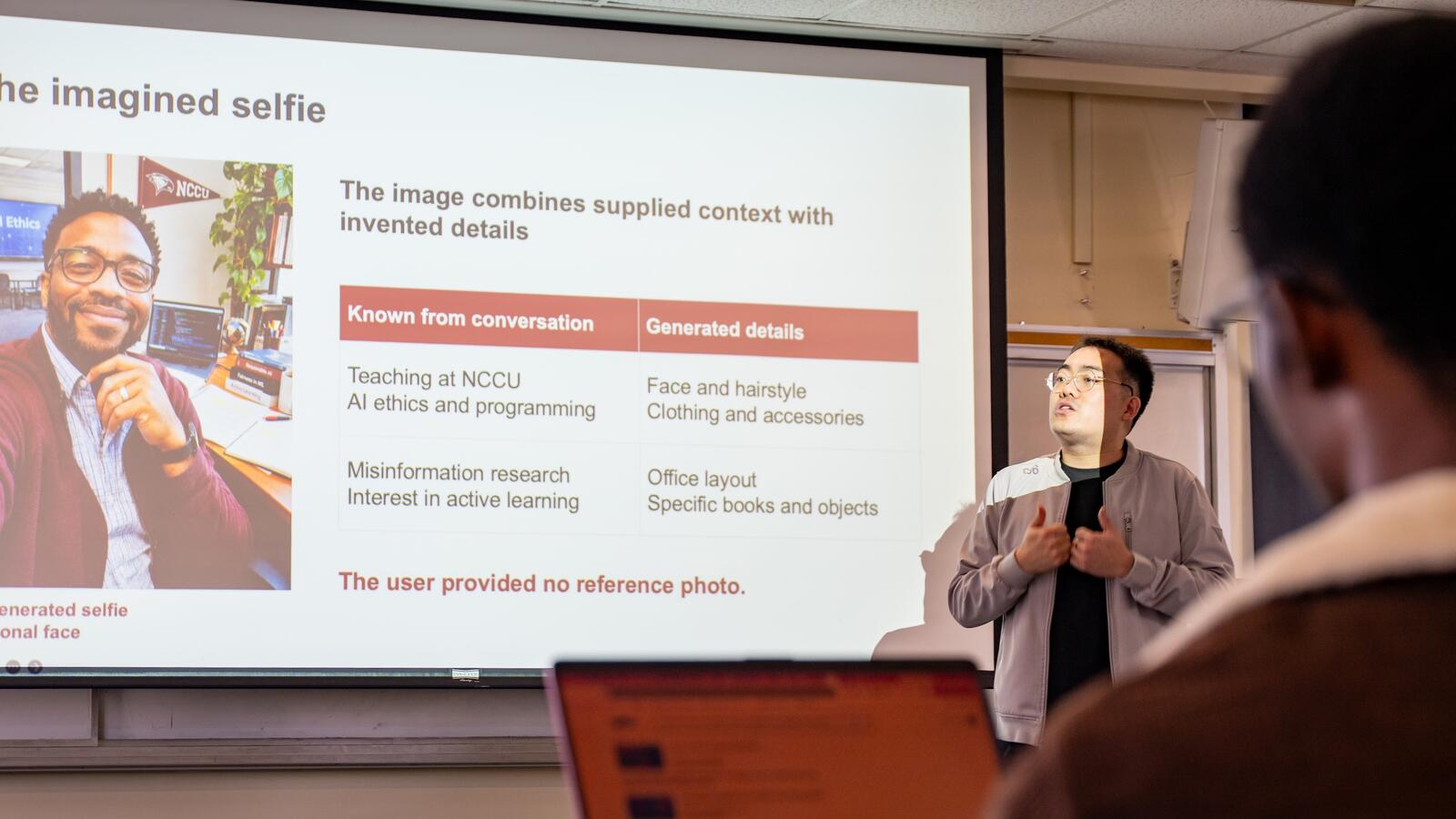
This fall, North Carolina Central University (NCCU) continued to increase its offerings in artificial intelligence (AI) by launching an AI minor.
“AI is critically important in every sector,” said Kimberly Weems, Ph.D., chair of mathematics and physics where the minor is administratively housed. “NCCU wants to make sure our students are well versed and receive the education to learn and interact in an AI world.”
While minors are usually developed in one department, the AI minor was a campus effort, said Ontario Wooden, Ph.D., provost and vice chancellor for academic affairs.
“The goal was to create something that was university-wide,” said Wooden. “We want different viewpoints and voices as part of the information from which AI pulls.”
The minor is open to all students, regardless of major.
“Psychology, biology, English, etc.,” Wooden said. “It’s intended to whet your appetite for AI and to learn the fundamentals.”
Of equal importance, the courses appear designed to be accessible to all students. The minor emphasizes AI literacy, ethical decision making and real-world applications while de-empathizing advanced programming and advanced mathematics.
The AI minor joins an AI module that was added to the mandatory UNIV 1100 course for all first-year students, the Institute for Artificial Intelligence and Emerging Research (IAIER) and its recently dedicated building on the corner of Fayetteville and Lawson streets.
Courses for minor
The 21-credit minor is composed of three core courses (3 credits each) in AI foundations, algorithmic thinking and ethics, plus a choice of 12 credits of elective courses from three tracks:
- Public Affairs, Business and Innovation
- Art, Culture, History and Language
- STEM and Health
The following course are being offered this fall:
- Exploratory Data Analysis (CEMA 1030)
- Business Programming (CIS 2000)
- Computing Tools for Data Science (CEMA 1520)
- AI for Business and Society (CIS 2050)
In spring 2027, the following courses will be offered:
- Introduction to Artificial Intelligence (AIER 2000)
- Business Programming (CIS 2000)
- AI for Business and Society (CIS 2050)
- Exploratory Data Analysis (CEMA 1030)
- Computing Tools for Data Science (CEMA 1520)
- Machine Learning for All (CEMA 2030)
- Responsible Data Science (tentative) (CEMA 2050)
- Applied Data Science for Geoscience (GEOG 4820)