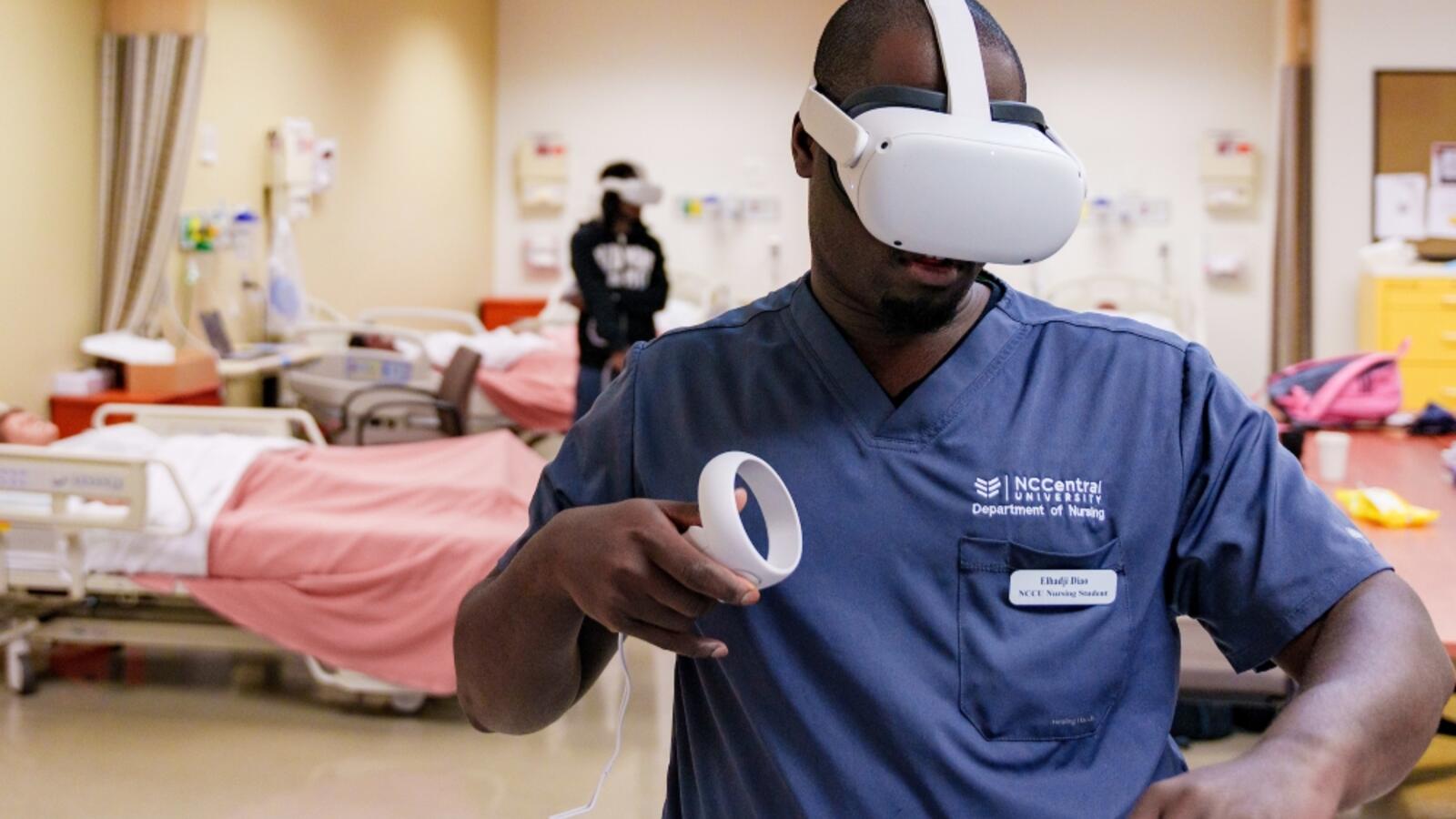
As one of the nation’s leading historically Black colleges and universities (HBCUs), North Carolina Central University (NCCU) has always embraced our mission to prepare nurses not only for today’s workforce, but for the healthcare landscape of tomorrow. Now, the institution is taking that commitment to the next level with bold advances in virtual reality and artificial intelligence that are redefining what nursing education can be.
Expanding access, deepening readiness
Unlike larger institutions in the Triangle Region, NCCU has historically faced barriers to securing sufficient clinical placements for our students. But where some might see limits, the university sees opportunity.
By integrating immersive virtual clinical experiences into the curriculum, NCCU is expanding access to high-quality training, giving nursing students exposure to scenarios they might never encounter in traditional placements — from managing multiple patients simultaneously to responding to pediatric emergencies or post-surgical complications.
This innovation is rooted in vrClinicals for Nursing, developed by nursing education technology leaders Wolters Kluwer and Laerdal Medical — and features clinical scenarios authored in collaboration with the National League for Nursing (NLN). The platform places students in realistic care settings where they must recognize patient cues, prioritize actions and think critically under pressure — the very skills that define successful nurses. The result: repeated, hands-on practice that turns knowledge into muscle memory and bridges the gap between classroom and clinic.
A commitment to leading through innovation
NCCU’s investment in virtual simulation reflects more than a response to immediate challenges — it’s a reflection of the institution’s long-term vision. As Mohammed Ahmed, Ph.D., dean of NCCU’s College of Health and Sciences notes, this is about mission as much as technology.
“We serve communities that depend on us to lead, and that means we must prepare nurses not just to meet today’s expectations, but to shape what nursing will become,” Ahmed said. “Embracing virtual reality, AI and new models of simulation is part of that work. It allows us to expand opportunity, deepen learning and ensure that our graduates are ready to practice in a healthcare environment that is changing faster than ever.”
That leadership mindset is visible across NCCU’s nursing program. It has threaded simulation throughout the curriculum — not just in clinical courses — so students build judgment, confidence and communication skills from their earliest days on campus.
Conversational AI: A new level of realism
What’s particularly exciting about vrClinicals is its use of conversational AI to power clinical scenarios. Instead of clicking through scripted options, students speak directly with virtual patients, adapting their language for different ages, backgrounds and clinical situations. They practice how to gather information, build trust and respond in real time — the same communication skills they’ll rely on in practice.
And it aligns perfectly with NCCU’s broader leadership in AI. In December 2024, the university launched the nation’s first HBCU-based Institute for Artificial Intelligence and Emerging Research, backed by a $1 million grant from Google.org. Since then, the institute has expanded partnerships with OpenAI, IBM, Anthropic, Cisco, Dell and AWS Academy to deliver interdisciplinary coursework, research opportunities and mentorship — all aimed at positioning our students as future leaders in AI innovation. NCCU’s approach to nursing education is part of that vision, connecting classroom learning with the technologies reshaping healthcare.
Equipping our students and faculty for a tech-driven future
NCCU faculty benefits, too. AI tools support more efficient teaching by offering on-demand explanations, Socratic-style questioning to reinforce critical thinking and data insights that show where students are struggling. That feedback loop allows us to tailor instruction and target skill gaps, all while preserving academic integrity and deepening students’ understanding of complex concepts.
A model for the region and beyond
NCCU’s leadership in immersive simulation and AI is setting a new standard for nursing education in North Carolina and across the nation. It’s proof that resource constraints don’t have to limit ambition, and that mission-driven institutions like NCCU can lead boldly in transforming how nurses are prepared for practice.